

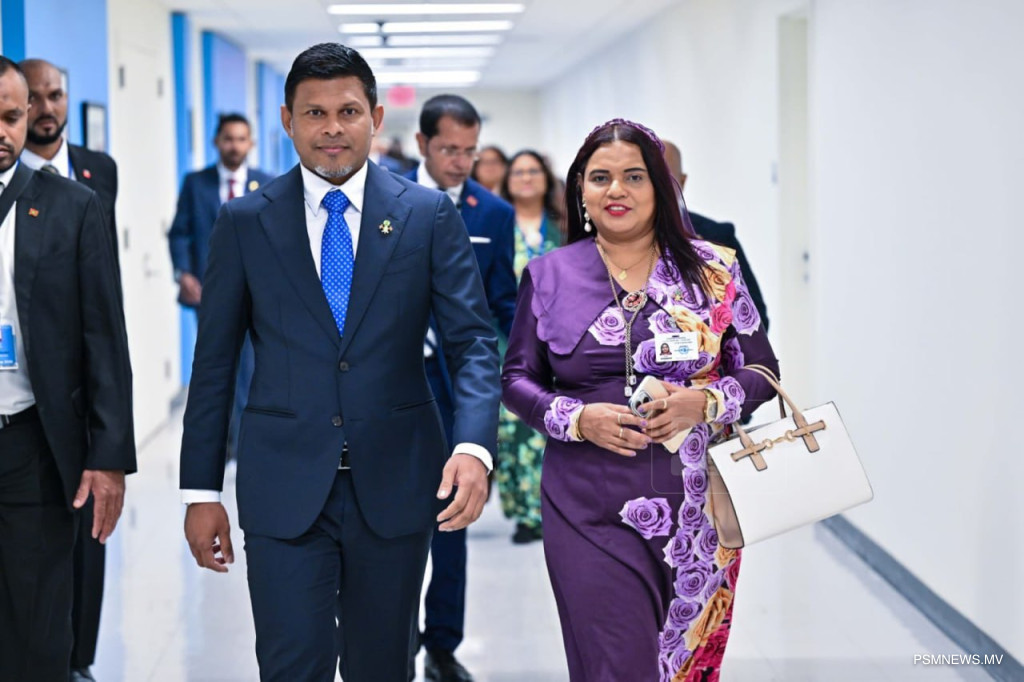
Vice President Hussain Mohamed Latheef has linked the Maldives’ ambition to become a developed country by 2040 with the need for greater access to climate finance and stronger international support for Small Island Developing States (SIDS).
Addressing the 81st session of the United Nations General Assembly, Vice President said President Dr Mohamed Muizzu had set a clear national ambition for the Maldives to become a developed country by 2040.
He said the government was pursuing that goal by raising productivity, diversifying the economy, building resilient infrastructure, expanding renewable energy and investing in Maldivians.
“Our future will be built by Maldivians,” the Vice President said.
But he warned that the international system could either widen or narrow the choices available to countries such as the Maldives.
“Technology transfer, resilient supply chains and accessible finance expand choice. Technological dependence, external shocks and unsustainable debt limits it,” he said.
The remarks placed access to finance at the centre of the Maldives’ wider development strategy, particularly as the country faces the growing costs of adapting to climate change.
Vice President said climate change was one of the most consequential forces limiting the ability of SIDS to shape their own futures.
For island states, he said, rising seas were no longer simply an environmental concern but a matter of national planning and security.
“Resilience demands the means to act,” he said, arguing that climate finance must reach vulnerable countries at the scale and speed required to build resilience.
He called for finance to be predictable and accessible, with greater reliance on grants and highly concessional funding for SIDS.
The Maldives has repeatedly argued that its small size, geographic isolation and exposure to external shocks create financing challenges that are not adequately reflected in conventional measures of development or access to concessional finance. The government has also called for reforms to international financial institutions and greater access to affordable finance for climate adaptation.
Vice President said the Maldives' development ambitions must therefore be supported by changes in the international financial architecture.
He called for implementation of the Sevilla Commitment on development finance, including its commitments on finance, debt and reform.
He also highlighted the Borrowers’ Platform, launched earlier this year by the Maldives and other developing countries, saying it should become a lasting mechanism that gives developing countries a greater voice in shaping the international financial system.
For SIDS, the Vice President said greater national agency also depended on progress at home.
“We must build our institutions, improve stability, and attract responsible investment and meaningful partnerships,” he said.
Such partnerships, he added, should strengthen national capacity and support national ambitions rather than create new forms of dependence.
Vice President described this as the principle behind President Muizzu’s “Maldives First” policy, which he said was based on partnerships built around respect, national interests and mutual contribution.
The government has previously outlined its 2040 ambition alongside efforts to diversify the economy, strengthen infrastructure, expand investment and improve the country's resilience. President Muizzu has also identified improved access to affordable financing, climate adaptation finance and debt sustainability as priorities for SIDS.
The Vice President said the same principle should apply to climate action.
For the Maldives and other low-lying island states, he said, rising seas threaten infrastructure, economies and livelihoods. In a separate address at the UN on sea-level rise, he called for adaptation finance to be predictable, accessible, grant-based or highly concessional, and delivered more quickly.
In his General Assembly speech, Vice President also called for faster implementation of the 2030 Agenda and measurable progress on the Antigua and Barbuda Agenda for SIDS.
He said the upcoming COP31 in Antalya must be a “COP of delivery”, with implementation used as the measure of international commitment.
“Global commitments matter only when they enable progress at home,” he said.
For the Maldives, that means ensuring that international cooperation strengthens its ability to pursue its own development priorities while reducing exposure to external shocks.
Vice President said artificial intelligence, technology transfer, resilient supply chains and accessible finance could expand the choices available to small states, while dependence, debt and external shocks could narrow them.
The broader message of the speech was that development and sovereignty are closely connected for countries such as the Maldives.
The Vice President argued that international partnerships should leave countries more capable than before, while international finance should provide the space needed for vulnerable states to invest in resilience and development.
“Partnerships must serve national needs, strengthen what we have and leave us more capable than before,” he said.
The Maldives’ 2040 ambition, therefore, was presented not only as a domestic development target but also as part of a wider call for an international system that gives small states the financial capacity and policy space to determine their own future.