

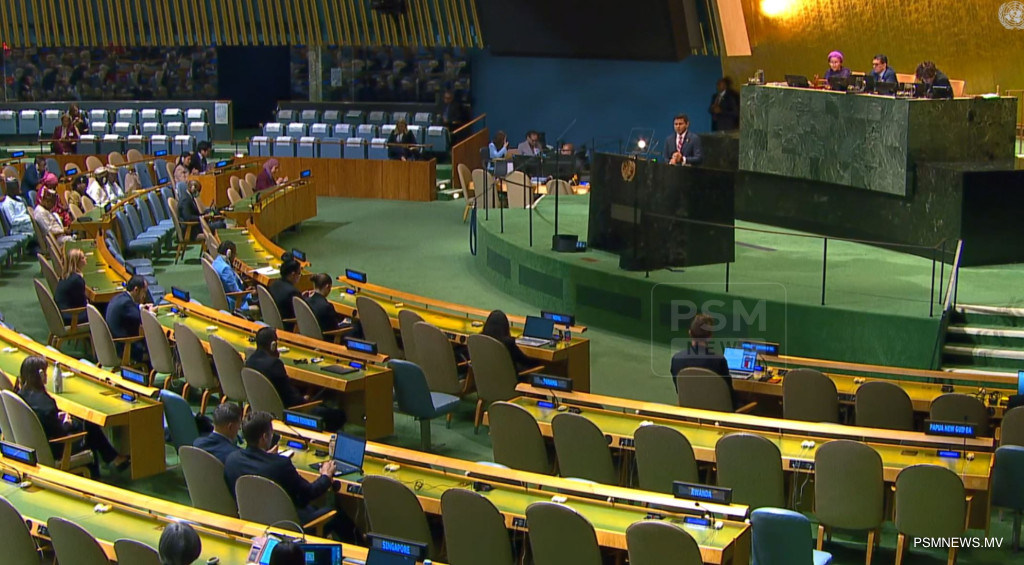
Vice President Hussain Mohamed Latheef has called for a comprehensive reform of the United Nations Security Council, saying the body must better reflect the world it serves and give small states a greater role in global decision-making.
Addressing the 81st session of the UN General Assembly, the Vice President said the Security Council could not continue to reflect the international system of 1945 while making decisions for the world of today.
He called for the Council to be expanded in both permanent and non-permanent categories, with greater representation for Africa and a rotating seat for Small Island Developing States (SIDS).
“The Security Council cannot reflect the world of 1945 while deciding for the world of today,” Vice President said.
He also called for the abolition of the veto held by the five permanent members of the Council.
In his address, Vice President linked Security Council reform to the wider question of whether the international system can provide smaller countries with the ability to determine their own futures.
He said the Maldives had raised concerns about the vulnerability of small states to external threats nearly four decades ago, and argued that the nature of those threats had since expanded.
“Insecurity now travels through sea lanes, supply chains, financial markets, digital networks and new technologies,” he said.
The Vice President said sovereignty could now be weakened without a physical border being crossed, including when external powers limit a country's freedom to make its own choices.
Against that backdrop, he argued that international institutions must ensure that small states are not merely subject to decisions made by larger powers.
“Small States must be decision-makers, not decision-takers,” he said.
Veto and equal application of international law
The call for Security Council reform formed part of a broader argument by the Maldives for equal application of international law.
Vice President said international law was the strongest safeguard available to countries facing unequal concentrations of power and argued that the same standards should apply to all states.
“No State should be shielded from accountability by its power or political alliances,” he said.
He connected this principle to the Maldives' position on conflicts, including the war in Gaza, arguing that international institutions must be able to act consistently regardless of the power of the parties involved.
Greater representation for small states
The Vice President said representation was important not only as a matter of fairness but because the composition of international institutions influences which issues receive attention.
“Who sits at the table shapes what the table sees,” he said.
For the Maldives, that includes issues such as climate change, debt, trade, supply chains and maritime security, which Vice President said were closely interconnected for small island states.
He argued that small states should have a stronger presence in international decision-making bodies because their vulnerabilities and priorities are often different from those of larger countries.
The Maldives is due to take a seat on the UN Economic and Social Council for the 2027–2029 term and is seeking election to the Human Rights Council for 2028–2030. It is also seeking a seat on the Security Council for the 2033–2034 term.
Vice President said those efforts reflected the Maldives' view that small states should participate directly in decisions affecting the international system.
Reform beyond the Security Council
The Vice President extended the call for greater representation to the wider UN system, arguing that institutional reform was necessary if the organisation was to restore trust.
He said the UN80 reform initiative should reduce duplication and improve accountability, but warned that efficiency should not simply mean reducing resources or withdrawing the UN from countries that need its support.
For SIDS, he said, reform should preserve a meaningful UN presence on the ground.
The reform process, he added, should remain member-state-led, inclusive and transparent.
Vice President also addressed the selection of the next UN Secretary-General, as Secretary-General António Guterres approaches the end of his tenure.
He said the selection process should be transparent and merit-based and draw on the full range of talent available to the organisation.
“For more than eight decades, every Secretary-General has been a man,” he said. “It is time for a woman to lead this Organisation.”
Sovereignty at the centre of Maldives' message
The Security Council reform proposal was ultimately presented as part of a broader Maldives call for what the Vice President described as a “sovereign future” for every state.
He argued that the same principle should guide international cooperation on conflict, climate change, finance, technology and institutional reform.
The test, he said, should be whether international decisions expand a state's freedom to choose, strengthen national capacity and reduce dependence.
The Maldives' position on UN reform therefore extends beyond changing the composition of one institution. It links representation, international law and institutional accountability to the ability of smaller countries to protect their sovereignty and participate in decisions affecting them.
In closing, Vice President returned to the Maldives' longstanding advocacy for small states, saying that while the country had called on the UN in 1989 to protect small states from external threats, it was now asking the organisation to protect something equally fundamental: "every state's freedom to choose its own future."