

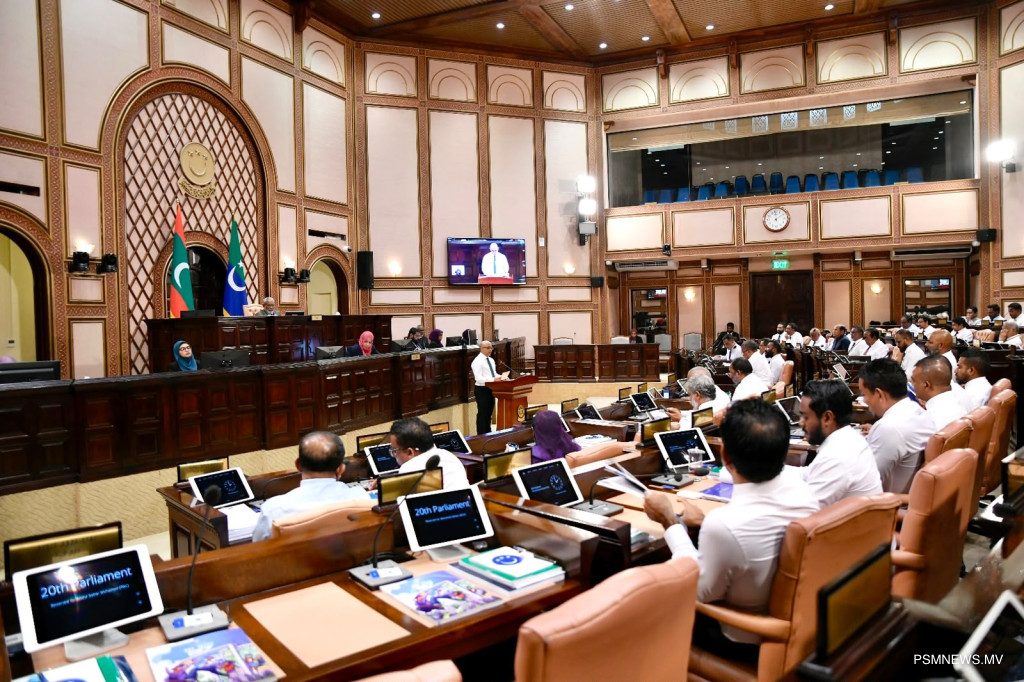
A proposed state budget of USD 3.87 billion for the coming year has been submitted to the Parliament, presented by Hassan Zareer, the Minister of Finance And Public Enterprises. The overall spending plan marks a reduction of USD 291.83 million compared with the USD 4.16 billion budget approved for the current fiscal year.
Total state expenditure for 2027 is projected at USD 3.41 billion, with recurrent operational costs accounting for USD 2.77 billion. Capital expenditure for public development projects is allocated USD 642.02 million, within which the Public Sector Investment Programme accounts for USD 531.78 million. State revenue and grants for 2027 are estimated at USD 2.80 billion, representing an increase of USD 90.79 million over 2026 projections, before climbing steadily to USD 3.02 billion in 2028 and USD 3.22 billion in 2029.
The fiscal framework serves as a foundational step toward achieving developed nation status for the Maldives by 2040, Minister Zareer stated, noting that targeted investments will deliver positive transformation across the country. The administration aims to complete 70 per cent of contracted and ongoing development projects without raising state taxes. Across 10 primary functional sectors, the healthcare sector received the largest single allocation, at USD 661.48 million.
Tourism performance and macroeconomic headwinds
Tourism remains the primary engine driving economic growth in the Maldives, but external geopolitical friction has disrupted global commerce and transit networks, Minister Zareer observed, noting that expansion in 2026 was constrained by the ongoing conflict in the Middle East.
"Fuel prices in the global market rose dramatically," Minister Zareer explained, pointing out that escalated air transport costs and flight reductions, alongside severe disruptions at Middle Eastern transit hubs for European travellers, directly undermined visitor arrivals.
Tourist arrivals in March and April fell by 23 per cent compared with the same period in 2025, while year-to-date arrivals as of 27 October reflected a 3.7 per cent decline year-over-year. Consequently, full-year tourism targets for 2026 will fall short of initial projections, with arrival figures projected to reach 2.17 million visitors generating 13.9 million bed-nights.
To reinvigorate the industry, the government designated 2027 as 'Visit Maldives Year'. Baseline projections estimate 2.28 million tourist arrivals in 2027, with promotional campaigns expected to attract more than 200,000 additional visitors to reach a target of 2.5 million, while bed-nights spent in the country are projected to climb to 14.5 million through coordinated marketing and expanded international flight connectivity.
Housing strategy and equity assistance framework
Addressing nationwide housing demand remains a central pillar of the 2027 budget, which allocates USD 194.55 million toward housing projects, an increase from the USD 129.70 million allocated in 2026. Recent state housing schemes drew over 58,000 applications, underscoring intense public demand across the country.
Housing expansion projects are accelerating across multiple regions under the direct supervision of President Dr Mohamed Muizzu to deliver a permanent solution to residential scarcity. "Specifically for this purpose, MVR 3.0 billion [USD 194.55 million] has been included in the 2027 budget," Minister Zareer stated, describing the expenditure as a comprehensive measure to ease congestion across the capital.
To assist private landowners lacking capital, the government is extending concessional Islamic financing and equity-matching facilities through financial institutions. Within this programme, USD 48.64 million is designated as non-repayable equity support for first-time builders and buyers, fulfilling a pledge previously announced by President Muizzu. Under the 'Hiyaavahi' Finance Facility in 2026, the state disbursed over USD 64.85 million to more than 800 applicants through Bank of Maldives at a 5 per cent profit margin. Physical construction remains active on more than 4,000 housing units in Malé, alongside procurement across 57 island communities.
Fisheries, agriculture, and resource regulation
To safeguard economic independence and food security, the 2027 budget prioritises substantial infrastructure development in fisheries and agriculture, Minister Zareer affirmed, identifying storage capacity enhancement as a core component of next year's fisheries programme.
"In this regard, looking at the fishing industry, projects to establish an additional 11,400 tonnes of storage capacity will proceed during 2027," Minister Zareer explained, noting that increasing daily ice production capacity by an additional 550 tonnes has been included in the upcoming budget.
The ice production expansion incorporates specialised facilities tailored for reef fishing operations, while mariculture development plans continue to advance alongside processing capabilities. A new yellowfin tuna packing facility in Hulhumalé is scheduled to provide small and medium enterprises with direct opportunities to earn foreign exchange revenue.
Agricultural policies administered under a unified ministry aim to strengthen national food security and reduce reliance on food imports, establishing policy structures to restrict imports of easily cultivable agricultural goods while securing fair market prices for local farming produce. To maximise the sustainable utility of natural resources, legislation governing uninhabited islands and lagoons will take effect within the year, establishing an equitable framework for commercial development.
Healthcare system restructuring and regional expansion
The 2027 budget commits USD 661.48 million to the healthcare sector to establish a high-quality medical delivery framework across all geographic regions of the country. To streamline public health administration, the government will establish the 'Maldives Tertiary Hospitals Group', uniting existing tertiary facilities and regional hospitals slated for tertiary upgrade.
"This will provide additional momentum to efforts aimed at elevating the quality of treatment provided to patients across various regions of the Maldives," Minister Zareer noted during his presentation to the legislature.
The fiscal plan establishes a centralised procurement system for hospital consumables and medical equipment, reinforcing the 'State Pharma' framework to optimise pharmaceutical purchasing and guarantee uninterrupted public access to essential medicine. Nationwide health capital outlays will expand diagnostic and clinical capabilities across outer atolls, funding hyperbaric decompression chambers, X-ray facilities, CT scans, and MRI equipment.
Clinical priorities also encompass specialised dental care, otolaryngology, gynaecology, obstetrics, and fertility services. Upgrading regional healthcare systems remains an essential priority to safeguard public health and ensure long-term national resilience, Minister Zareer underscored, as the administration seeks to decentralise clinical treatment and raise standards of patient care throughout the island nation.
Education investment prioritised in 2027 budget
The 2027 budget prioritises education infrastructure and access to quality education, with plans to construct classrooms and multipurpose halls, establish laboratories and strengthen facilities for higher education across the Maldives. The budget also includes measures to strengthen inclusive education by providing resources for children with disabilities and improving school infrastructure to accommodate diverse learning needs.
A total of USD 8.8 million has been allocated to continue the free degree programme, while more than USD 42.2 million has been earmarked for student loan facilities for higher education in 2027.