

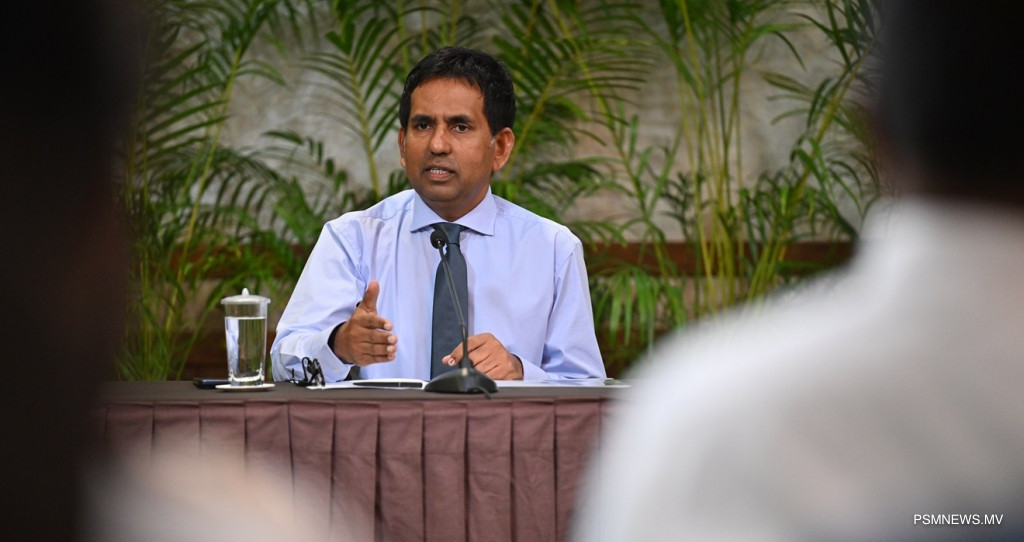
The government has worked continuously to resolve the US dollar shortage, though critical preliminary measures to prevent the country from going bankrupt were required before systemic foreign exchange reforms could be implemented, according to Mohamed Saeed, the Minister of Economic Development, Transport and Trade.
Addressing a recent President’s Office press conference on delays in curbing high-rate currency sales, Minister Saeed explained that foundational economic stabilisation preceded targeted interventions, which now ease access for students and travellers abroad. Rejecting criticism over informal currency markets, he defended the administration’s record.
“You highlighted measures that no government dared to take,” Minister Saeed asserted. “Everyone recognises that action is being taken now. The business community in the Maldives carries out extensive work alongside us every day.”
Scrutiny of parallel channels demands careful analysis. “Claiming that a [US] dollar black market exists in the Maldives may be easy after examining matters superficially,” he cautioned. “A government intervenes in such a matter only after examining things thoroughly.” Formal legal proceedings are now underway against unauthorised operators reported through a dedicated state hotline.
Structural imbalances persist because significant resort revenues remain offshore rather than entering domestic banks, the International Monetary Fund observed. Enacting the Foreign Currency Regulation on 1 October 2024 to repeal earlier rules, the government aims to channel receipts domestically. The Maldives Monetary Authority reported that achieving monetary stability requires narrowing parallel-rate disparities and reinforcing national reserves.