

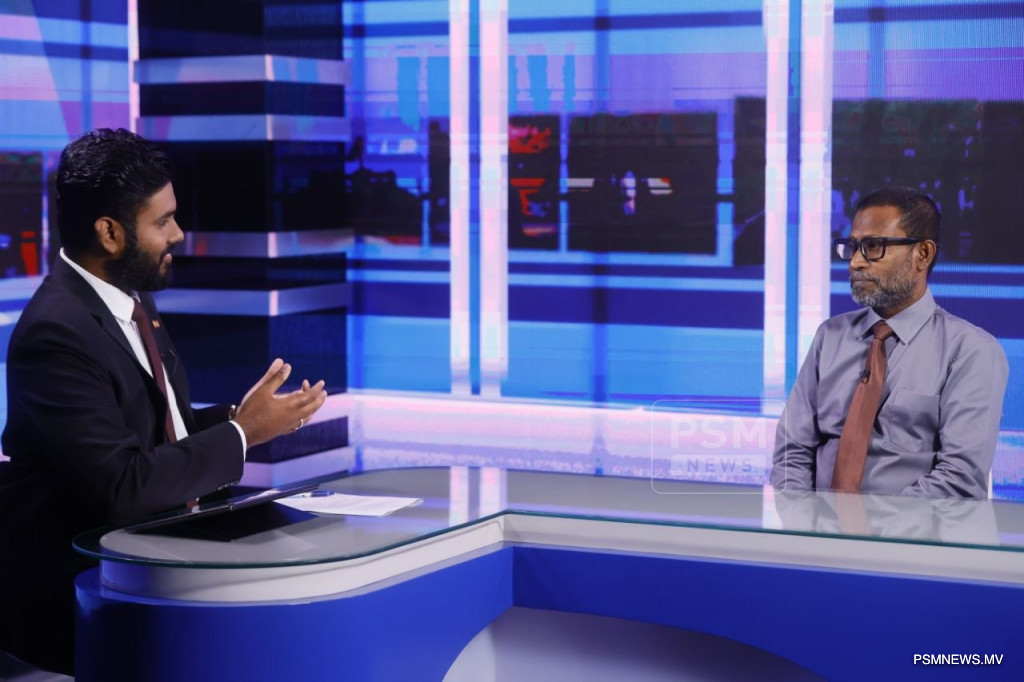
The Ministry of Climate Change, Environment and Energy has said that studies are underway to find sustainable solutions to the plastic waste problem facing the Maldives.
Single-use plastic is a major source of environmental damage. As sustainable solutions are needed to address this issue, work is currently underway to study different models that could be introduced in the Maldives.
Speaking on PSM News’ 'Raajje Miadhu' programme, Director General of Waste Management and Pollution Control Ahmed Murthaza said studies of different models are being conducted as part of efforts to address the plastic waste problem sustainably. In this regard, work is underway to develop a framework for introducing Extended Producer Responsibility (EPR).
“With the introduction of EPR, it would not be necessary to ban plastic bottles of a particular size. We believe that collection centres could be established, reducing the number of bottles that are discarded. We are conducting studies on how this can be implemented in a country like the Maldives, where EPR has not yet been introduced. An EPR framework has now been developed,” Murthaza said.
EPR, or Extended Producer Responsibility, is a system under which manufacturers or companies that place products on the market are held responsible for those products. However, rather than banning plastic products of specific sizes, introducing this system in the Maldives would establish an organised collection or waste-management system. As a result, the number of plastic bottles discarded into the environment and other areas could be significantly reduced.
Although implementing EPR in an island nation such as the Maldives presents a number of challenges, specific studies are being carried out to ensure that the system can be implemented successfully. Based on these studies, a national EPR framework could be developed. Under the framework, the types of products covered by the system would be determined.
Murthaza said the plan is to include plastic products of specific sizes, other types of products, and products containing materials that are harmful to the environment.
Two main models have been identified for implementing EPR in the Maldives.
Take-back system: Under this system, once a product imported into the Maldives reaches the end of its useful life, arrangements would be made for the product to be returned or removed from the Maldives by the company that produced it. This is a system that is already being successfully implemented in some developed countries.
Container deposit scheme: Under this system, a specific charge or deposit would be collected at the point of entry when goods are imported into the Maldives. Although the cost would ultimately be passed on to the consumer as part of the product price, the consumer would receive the deposit back after returning the bottle or container once the product has been used.
This is similar to the system previously used in the Maldives for Coca-Cola glass bottles and is therefore a familiar system for Maldivians. As it is a system that has been used in the past, it is considered easy for the public to understand and could provide a significant solution to the waste problem.
The Government is working to establish these systems and put in place the necessary legal and administrative structures, with the aim of taking stronger measures to protect the Maldives’ environment.