

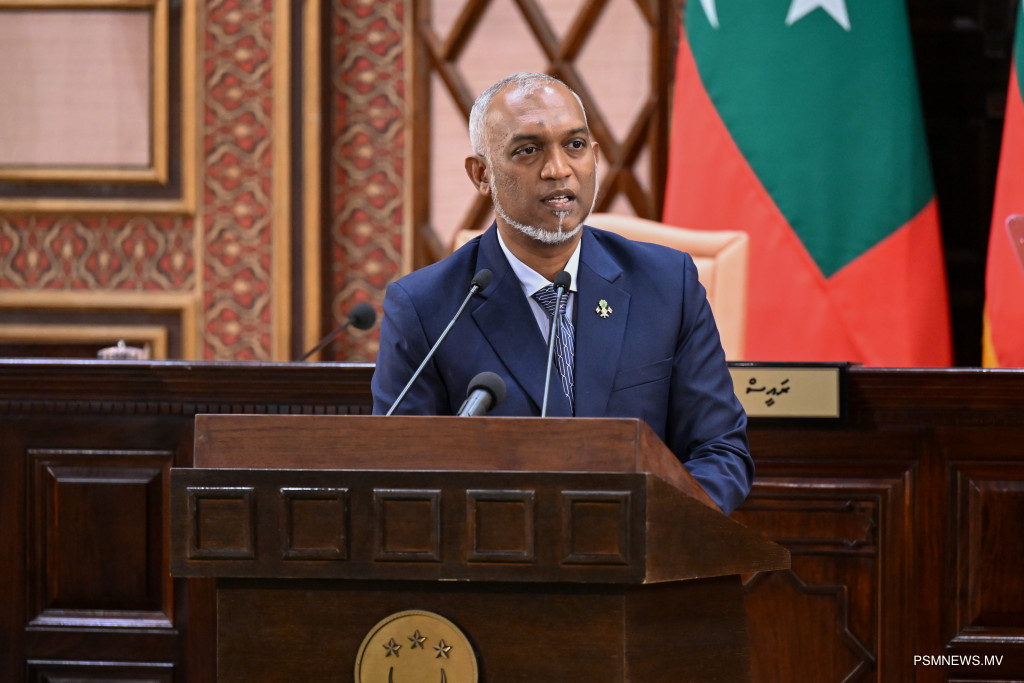
President Dr Mohamed Muizzu declared that broadening access to higher education across the atolls is indispensable to the country’s sustainable development. In his inaugural address to the opening session of Parliament, he outlined a strategy to decentralise academic infrastructure, announcing that the government has begun establishing campuses in every atoll currently without state-run institutions, a first in the nation’s history.
“Facilitating higher education for youth and individuals of all ages across the entire Maldives, ensuring that study opportunities are available in every atoll, is a vital measure in the pursuit of sustainable development,” President Muizzu said.
The administration has embarked on a significant expansion involving the country’s principal academic institutions. Twenty-six projects under the Maldives National University are underway across 16 atolls, while the Islamic University of Maldives is managing 12 projects in 10 atolls. Alongside these efforts, the government is pursuing 14 projects to establish academic facilities and is developing technical vocational centres in 10 atolls to strengthen skills training.
Attention has also turned to vocational education, with the president highlighting its role in aligning the workforce with economic demands. He noted that the Maldives Polytechnic began offering training programmes in specialised technical fields last year. The administration has reviewed vocational education within the school system and introduced a stream at the higher secondary level. This includes the establishment of the Maldives’ first Vocational High School, which he described as a critical element of efforts to elevate human capital and foster a productive youth population.
Financial access formed another central theme of the address. The president reported that the state awarded 852 scholarships and 880 loans in sectors deemed vital to national development. For students studying abroad, the government has eased foreign currency constraints by raising the bank withdrawal limit to USD 1,200 per month. Domestically, the administration this month launched the ‘Kuri’ system, a digital platform designed to eliminate service delays by replacing manual processing with automation, thereby providing a permanent solution to funding accessibility.
“It facilitates the immediate deposit of funds without documentation errors or delays, enabling students to monitor the payment process in real-time,” President Muizzu explained. “Furthermore, it brings an end to the prolonged waiting periods for loan eligibility checks; from the moment an application is submitted, immediate verification is conducted to determine if a student is enrolled in another course or has been blacklisted”.
Closing his remarks, the president highlighted the scale of investment in the First Degree Scheme. Over the past year, the state extended opportunities to 2,728 new students, bringing the total number of beneficiaries to 11,252, with cumulative expenditure exceeding USD 59.76 million.