

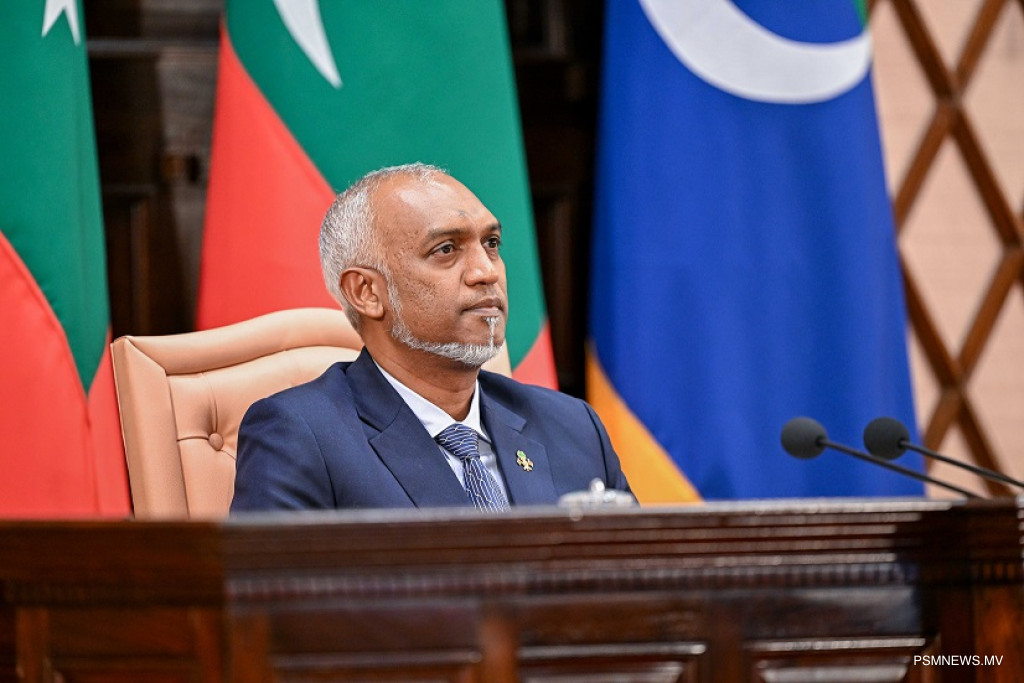
President Dr Mohamed Muizzu has formally launched efforts to reclaim the Chagos Archipelago, reversing the position of the previous administration and asserting Maldivian sovereignty over the territory. The announcement follows widespread public opposition to the former government’s recognition of Mauritius’s claim to the islands, a concession many citizens regarded as an unacceptable surrender of a region long considered part of the Maldivian sphere of influence.
Since assuming office, President Muizzu has made the reclamation of the Chagos Archipelago a central priority. In his third Presidential Address to Parliament on 5 February, he declared that the Maldives had engaged in discussions with the United Kingdom and formally invalidated the prior government’s decision. He confirmed that the Maldives had withdrawn its recognition of the archipelago as Mauritian territory and rescinded a letter sent by former President Ibrahim Mohamed Solih to the Mauritian Prime Minister. In a formal communication dispatched to Mauritius on Thursday, President Muizzu affirmed the reversal of the previous administration’s diplomatic stance.
In his letter, President Muizzu characterised the former administration’s policy as a damaging error made during critical international proceedings. He wrote that the abrupt decision, taken while hearings were underway at the International Tribunal for the Law of the Sea (ITLOS), had inflicted irreparable harm upon the nation. He added that a national inquiry would be convened to investigate the matter and underscored the historical ties binding the Maldives to the Chagos Archipelago.
A cabinet review of a report prepared by a special committee analysing the ITLOS ruling, which resulted in the loss of a significant portion of the Maldives’ southern waters, has prompted the government to initiate legal proceedings to recover the disputed section of its Exclusive Economic Zone (EEZ). Declaring that the state does not recognise any alteration to the territory defined by the Constitution, the administration has deployed the Maldives National Defence Force (MNDF) to patrol the contested waters. Surveillance operations are being conducted using the Coast Guard vessel ‘Dharumavantha’ and drones operated by the newly established MNDF Air Corps.

Officials noted that the nation’s territory, encompassing land, airspace, territorial seas and seabed, is inviolable, as defined by its archipelagic baselines and the 200-nautical-mile EEZ codified in maritime law. They noted that, apart from a 1976 agreement concerning the Gulf of Mannar with northern neighbours, the Maldives has never entered into any arrangement that compromises its maritime boundaries.
President Muizzu also addressed the domestic repercussions of the dispute, reiterating his commitment to accountability during his parliamentary address. “Given the counsel that irreparable damage has occurred, we intend to question the responsible parties to ascertain the underlying causes and pursue legal action where necessary,” he said. “To prevent the recurrence of such events, I announce the decision to establish a Commission of Inquiry under Article 115 of the Constitution.”
The Maldives bases its claim on both geographic proximity and historical evidence. The Chagos Archipelago lies approximately 310 miles south of Malé, the Maldivian capital, compared with a distance of roughly 1,300 miles from Mauritius and its capital, Port Louis. Historical records and physical artefacts reinforce these ties: gravestones inscribed in the Maldivian language found in Chagos are identical to ancient markers across the Maldives, attesting to a longstanding presence in the islands.
Centuries of Maldivian folklore recount the journeys of travellers and fishermen to the archipelago, while a royal decree issued by a 16th-century Maldivian monarch asserted sovereignty over the territory, a claim predating human settlement in Mauritius by more than a century. Modern scientific analysis has further substantiated these assertions. Carbon dating of archaeological finds and DNA testing of Chagossian descendants, who were forcibly displaced in the 1970s to make way for a UK-US military base, reveal clear genetic links to Maldivian and Creole ancestry.