

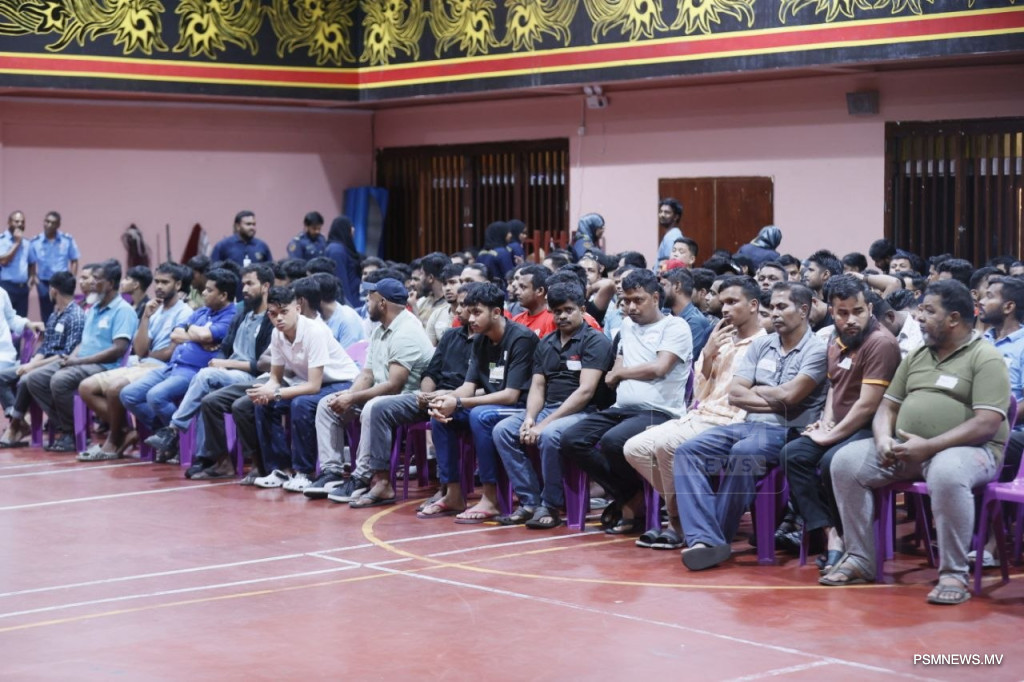
The Maldives is among three countries worldwide to have reduced the proportion of its foreign population without complete biometric identification to the one per cent threshold, following Government efforts to strengthen migration management and address a longstanding national security concern.
The management of the foreign population has long been one of the most widely discussed issues in the Maldives, particularly because of its implications for national security. The foreign population has continued to grow over the years, while the sharp increase in the number of expatriates living in violation of regulations has remained a concern among Maldivians.
Despite various efforts by successive governments, the country had yet to find a lasting solution to the issue. The Maldives has now made significant progress in addressing the issue, reaching a level recognised as a notable achievement by global standards.
Minister of Homeland Security and Technology Ali Ihusaan outlined the progress while addressing the High Council of the governing People's National Congress (PNC). He noted that expatriates account for one-third of the Maldives' total population.
When the current Government assumed office, documentation showed that 295,678 expatriates had been granted permission to reside in the Maldives. While State records indicated that this number of foreign workers should have been in the country, only 22,700 had been fingerprinted and their identities directly established, Minister Ihusaan said.
Minister Ihusaan described the situation as a major national security risk. He said the Maldives had treated the issue as relatively insignificant since the late 1980s, while many parties had focused on the money earned from bringing in and selling expatriates without considering the consequences for the country as a whole.
However, Minister Ihusaan said the Government made resolving the issue a priority after President Dr Mohamed Muizzu assumed office. He said extensive efforts initiated by the Ministry of Homeland Security and Technology to achieve that objective had since brought a major transformation.
Authorities have now collected the fingerprints and biometric information of 95 per cent of expatriates living in the Maldives, compared with only 22,700 people whose fingerprints had previously been recorded. Through the initiative, authorities have so far collected information on 294,000 expatriates.
The work has reduced the number of people currently in the country whose identities remain unknown to 1,102. Of the remaining five per cent, authorities have confirmed that four per cent are no longer in the Maldives. This means that only one per cent of expatriates currently in the country have yet to have their fingerprints and photographs recorded.
This represents a significant achievement by global standards. Only three countries worldwide have maintained the proportion of their foreign population who cannot be biometrically identified, or whose information remains incomplete, at the one per cent threshold: the Maldives, Singapore and the United Arab Emirates.
The Government has undertaken work of a global standard within a short period to address expatriate-related issues. Efforts continue to establish a permanent solution for expatriates living in violation of regulations by strengthening the management of work permits and continuously verifying the validity of those documents.
These measures represent an important and historic step towards safeguarding the Maldives' national security and safety.