

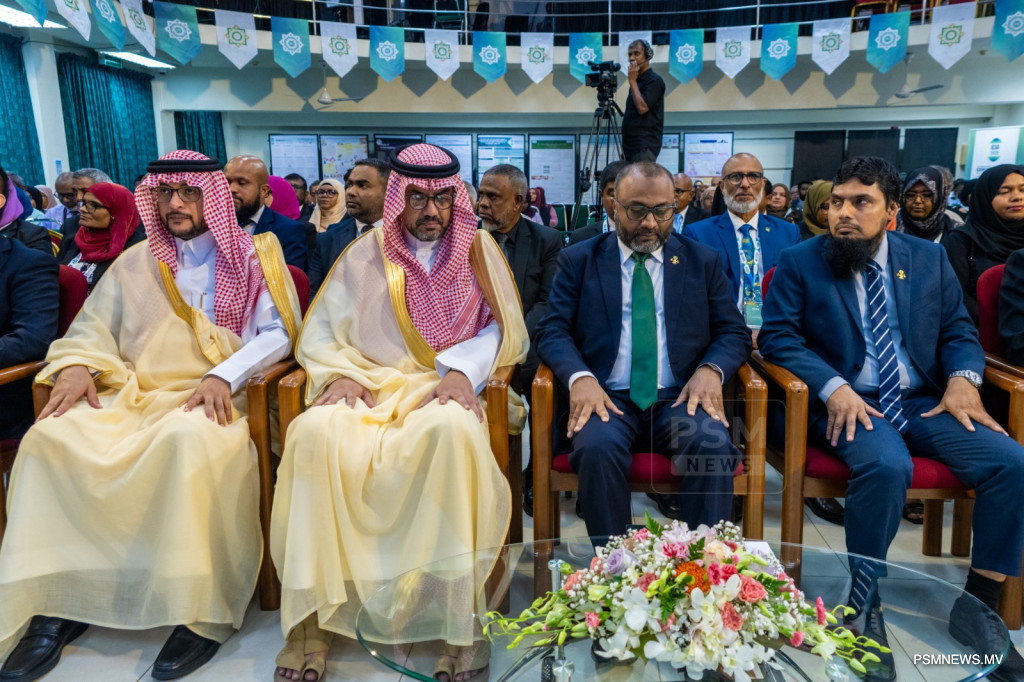
The Minister of Islamic Affairs and Endowments, Dr Mohamed Shaheem Ali Saeed, has emphasised that preserving the noble blessing of teaching knowledge—which serves as a vital catalyst for building humanity—is a profound responsibility.
The Minister made these remarks during his address at the opening ceremony of the 11th International Conference on Intellectual Advancement (ICIA), organised by the Islamic University of Maldives (IUM).
Speaking at the ceremony, Minister Shaheem praised IUM's unwavering spirit and enthusiasm in successfully hosting this international conference annually. He emphasised that a university’s true purpose extends far beyond classroom teaching to encompass community service, pioneering scientific research, and driving sustainable development—goals that IUM continues to champion.
Highlighting the divine value of education, Minister Shaheem said Allah SWT created human beings and placed them as stewards on Earth—not in isolation, but equipped with knowledge.
“He did not merely bestow knowledge. He also granted the supreme blessing of expressing and articulating that knowledge. There is a clear distinction between those who know and those who do not,” he explained.
To further support these academic endeavours, the Minister announced that, starting this year, the Ministry will officially sponsor the conference annually to bolster the vital work carried out by the IUM Research Center. He noted that the success of such initiatives relies heavily on collaboration and mutual support across different sectors of society.
The ICIA, which is the largest international symposium of its kind in the Maldives, has been held annually since 2016. Serving as a premier platform for knowledge exchange, scholarly debate, and evidence-based practical research, this year’s two-day conference features a diverse range of parallel academic and cultural sessions.
Reflecting its growing global footprint, this year’s event has registered 526 participants, including 344 in-person attendees and 182 online participants, with 53 scholars representing 18 different countries. Of the 167 papers submitted to the conference—which included 85 local and 83 international submissions—139 papers were accepted for presentation.
Prior to the main event, the university conducted 10 specialised workshops, drawing between 40 and 80 participants per session. According to IUM, these sessions are designed to enhance the research capabilities of students and academics, providing practical guidance on ethically applying modern tools and publishing in peer-reviewed international journals.
The university highlighted that the conference continues to achieve significant success in fostering a robust academic research environment, bringing local and international experts together to strengthen global academic networks.