

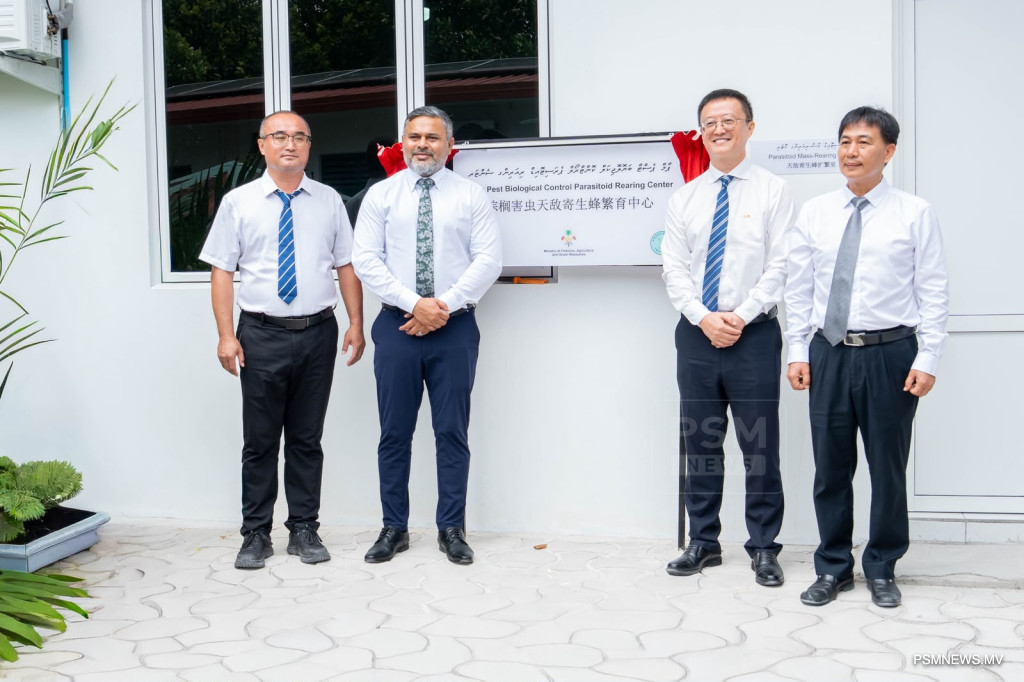
The Palm Pest Biological Control Parasitoid Rearing Center has been officially inaugurated at the Hanimaadhoo Agriculture Center, marking a significant step in the island nation’s fight against destructive coconut pests.
The facility was jointly opened by Minister of Fisheries, Agriculture and Ocean Resources, Ahmed Shiyam and Chinese Ambassador to the Maldives, Kong Xianhua, underscoring the bilateral cooperation behind the “Maldives Coconut Tree Pest Control Assistance Project.”
The centre, a cornerstone of the project launched under an Implementation Agreement signed on 14 July 2025 between the Ministry of Agriculture and China’s Ministry of Commerce, aims to rear beneficial insects that naturally attack the coconut leaf beetle, locally known as the Coconut Hispid Beetle. With a daily capacity of 100,000 parasitoids, the centre will supply environmentally friendly biological agents for release into infested areas, supporting sustainable pest management without reliance on chemical pesticides.
Since the beetle’s first detection in December 1999 at Sun Island Resort in Ari Atoll, the Maldives has pursued integrated pest‑management strategies, including a FAO‑collaborated initiative launched in September 2003. The new rearing centre strengthens those efforts by providing a steady supply of parasitoids, while complementary measures—such as tighter import regulations, inter‑island transport guidelines, public awareness campaigns, and quarantine enforcement—continue to curb the spread of the Hispid Beetle and related pests like the spiraling whitefly.
As part of the assistance project, a training programme was also conducted at Hanimaadhoo by experts from the Chinese Academy of Tropical Agricultural Sciences. The course combined theory and hands-on practice, focusing on biological pest‑control techniques and disease management, ensuring local technicians can operate the facility effectively and expand its impact across the archipelago.