

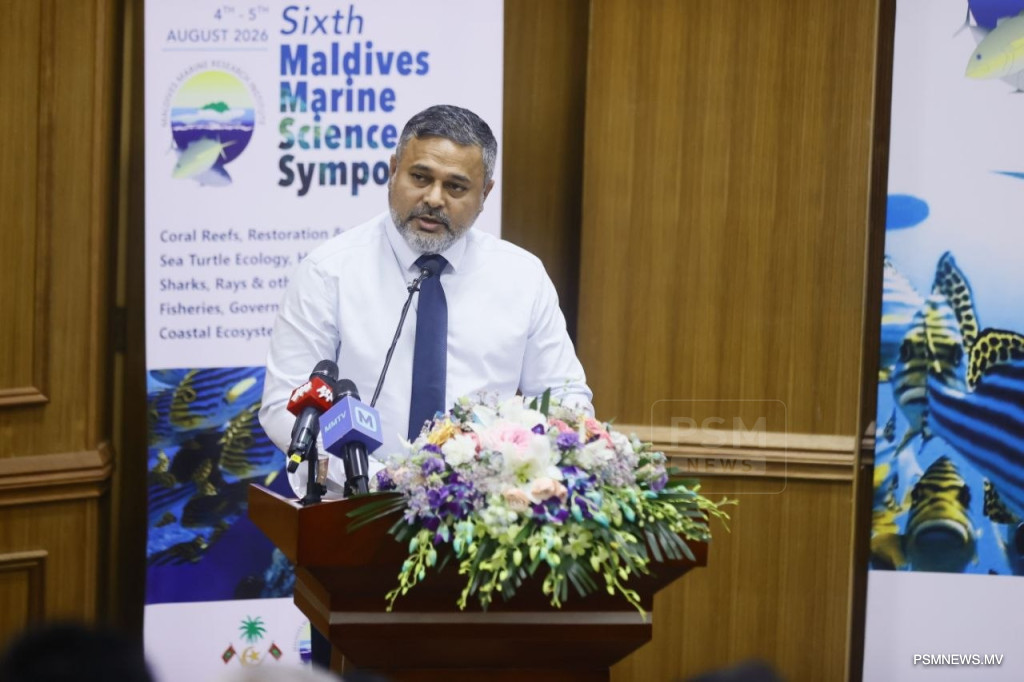
Scientific research has become more important than ever to protect the Maldives' marine resources and ensure they are used sustainably, Minister of Fisheries, Agriculture and Ocean Resources Ahmed Shiyam has said.
The Minister made the remarks while delivering the keynote address at the opening ceremony of the 6th Marine Science Symposium.
Minister Shiyam said the Maldives is one of the world's richest countries in terms of marine biodiversity and is home to some of the world's richest and most unique marine ecosystems. He said the country's vibrant coral reefs and abundant marine life form the foundation of the Maldivian economy and communities. He added that even after many years of scientific research, new discoveries continue to emerge from the oceans, demonstrating that there is still much left to learn.
Highlighting the threats posed by climate change, the Minister said the Maldives is one of the countries most vulnerable to its adverse impacts. He noted that scientific research has now become more important than ever to understand the changes taking place in marine ecosystems as a result of climate change.
"The importance of scientific research has become greater than ever before. Therefore, we need to gather more information about our oceans and coral reefs and find scientific solutions that will help communities adapt to these changes. By investing in research and science, we can protect our marine environment, safeguard the livelihoods that depend on it, and build a sustainable future for generations to come," Minister Shiyam said.
Referring to President Dr Mohamed Muizzu's policy of building a knowledge-based society, Minister Shiyam said the Government is prioritising science-based decision-making to achieve economic prosperity. He added that the knowledge shared at the symposium would play an important role in shaping policies aimed at sustainably managing the country's marine resources.
The Minister also said the Government is giving special priority to increasing the participation of Maldivians in the marine science sector. He further noted that strengthening the Maldives' scientific capacity through collaboration between international experts and Maldivians is an important investment for future generations.
The Marine Science Symposium has been held since 2016 with the aim of providing a platform to share and discuss various research conducted in the Maldives' marine environment.
47 research papers to be presented at Marine Science Symposium
The symposium, organised by the Maldives Marine Research Institute (MMRI), is held once every two years and is taking place from 4 to 5 August at the Central Auditorium of the Maldives National University.
The Ministry of Fisheries, Agriculture and Ocean Resources said the symposium aims to share research and findings related to the Maldives' marine resources and marine life with the public, facilitate the exchange of knowledge among those working in the field, and advance the development of marine science in the Maldives.
The Ministry said the symposium is the only event of its kind in the Maldives dedicated to marine science and also aims to create greater opportunities for those actively engaged in the field.
Research conducted by organisations and universities involved in marine research in the Maldives is being presented at the symposium. A total of 47 research papers have been selected across five thematic areas, including 32 oral presentations and 15 poster presentations.
The five thematic areas are coral reefs, restoration and climate change; fisheries, governance and society; sea turtles, ecology, health and conservation; sharks, rays and other marine megafauna; and coastal ecosystems and seabirds.
Participants from both the Maldives and abroad are taking part in the symposium.
The Marine Science Symposium is regarded as a leading forum for scientists working in marine research. First organised by the Maldives Marine Research Institute in 2016, it has since been held every two years.