

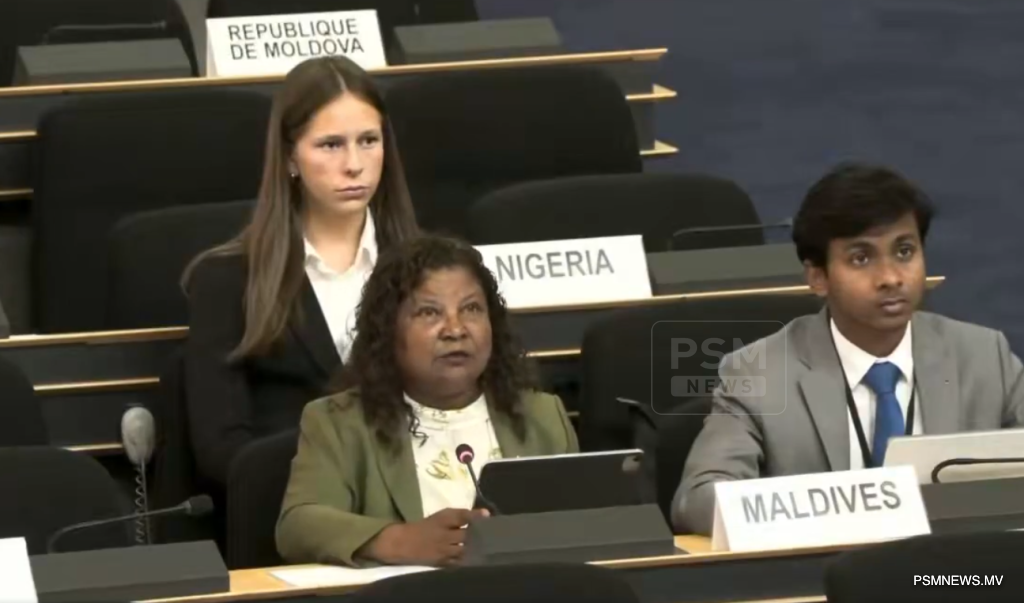
The Maldives has co-sponsored a resolution aimed at strengthening the independence and impartiality of the judiciary and legal profession during the 62nd session of the United Nations Human Rights Council, where it also advocated for the rights of the Palestinian people and backed a series of human rights initiatives.
The 62nd session of the Human Rights Council concluded in Geneva on Friday after the Council adopted 28 resolutions and appointed four Special Procedures mandate holders. The outcomes covered a broad range of thematic and country-specific issues.
Throughout the session, the Maldives maintained an active presence, delivering national statements on key thematic issues and co-sponsoring several resolutions in line with government priorities.
The country served as a member of the cross-regional core group for the resolution on the independence and impartiality of the judiciary, jurors and assessors, and the independence of lawyers. The resolution seeks to strengthen judicial independence, safeguard access to justice and the rule of law, address emerging challenges affecting justice systems, and renew the mandate of the Special Rapporteur on the independence of judges and lawyers for a further three years.
The resolution was adopted by consensus with 62 co-sponsors at the time of its adoption.
During the session, the Maldives also continued to advocate for the rights of the Palestinian people, including their right to self-determination. It called for the protection of civilians, unhindered humanitarian access, and a just and lasting peace based on international law and relevant United Nations resolutions.
The Maldives also co-sponsored resolutions on the right to education, the protection of health care in armed conflict, the enhancement of international cooperation in the field of human rights, and technical assistance and capacity-building to empower women's access to education and work in digital and cybersecurity-related fields.
According to the Maldives, these co-sponsorships reflect its continued commitment to advancing human rights, social justice and sustainable development at the international level.
The country also joined joint statements delivered on behalf of the Organisation of Islamic Cooperation (OIC).
Representing an Informal Group of Small Island Developing States (SIDS), the Maldives delivered a joint statement calling for demand-driven, country-owned technical cooperation and capacity-building to strengthen resilient and people-centred health systems tailored to the specific needs and circumstances of SIDS.
On the sidelines of the session, the Maldives partnered with The Bahamas, Fiji, Finland, the Republic of the Marshall Islands and Vanuatu, with the support of Universal Rights Group and the Essex Human Rights Centre, to organise a side event marking the 20th anniversary of the Human Rights Council.
Titled "A Small Islands Story: 20 Years of SIDS Advocacy and Influence at the Human Rights Council", the event reflected on the role and impact of small island developing states within the Council, highlighting their contributions as leaders, bridge-builders and advocates for human rights.
The Maldivian delegation was led by the Ambassador and Permanent Representative of the Maldives to the United Nations Office at Geneva, Dr Salma Rasheed. The delegation also included Counsellor Adam Hamid, Counsellor Aminath Shifaya Ibrahim, Second Secretary Aishath Rayahyn and Attache' Raaidh Saeedh from the Permanent Mission.