

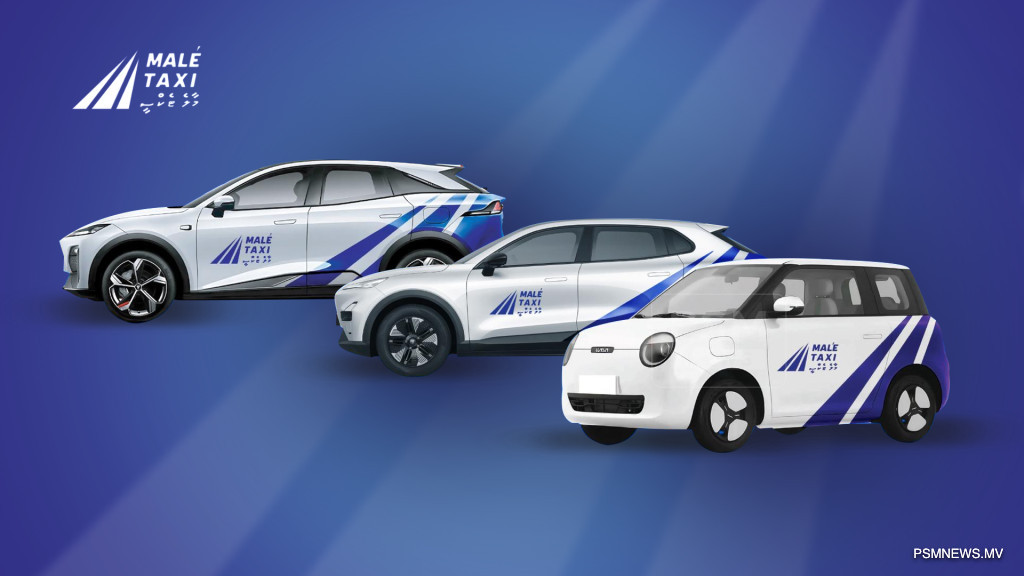
In response to growing public frustration over unreliable and inconsistent taxi services in the capital, the government is set to officially launch the Male’ Taxi service—a modern, state-led initiative aimed at transforming urban transportation.
With rapid population growth in Male’ and increased mobility due to the Sinamale’ Bridge connecting Male’, Hulhumale’, and Hulhule’, demand for efficient taxi services has surged. However, long wait times, price disparities, and traffic congestion have left commuters frustrated. Private taxi operators, while dominant in the market, have struggled to meet service expectations, often citing the challenges of navigating the narrow streets of Male’ as a major constraint.
To address these issues, the government has stepped in and is set to launch a fully state-owned taxi service under the management of the Maldives Transport and Contracting Company Limited (MTCC). The new Male’ Taxi fleet consists of 150 electric vehicles (EVs), carefully selected to balance efficiency, passenger comfort, and urban adaptability. The fleet includes three vehicle sizes—70 compact “Lumen” models designed for solo and short-distance travel, capable of carrying three passengers and small luggage, 60 mid-sized S05 vehicles and 20 larger S07 models suited for airport transfers and family trips, each accommodating up to four passengers with expanded cargo space.
Notably, the introduction of electric vehicles marks a significant shift toward sustainable urban mobility. EVs are not only quieter and environmentally friendly but also cheaper to maintain—offering long-term benefits for both service providers and passengers.
The entire service will be operated through a dedicated mobile application, ensuring a seamless booking experience, transparent pricing, and real-time tracking. All drivers will undergo specialised training, and fares will be standardised—addressing widespread complaints about fare inconsistency.
Despite initial concerns about the size of some vehicles in the tightly packed streets of Male’, officials emphasise that the vehicle selection was part of a thorough, data-driven plan to ensure functionality without compromising comfort or accessibility. With 70 percent of the fleet composed of compact city-friendly models, the service aims to reduce congestion while improving ride availability.
According to the government, the Male’ Taxi initiative is more than just a transportation upgrade—it's a benchmark for quality and reliability in the nation’s public services. By setting new standards in pricing, sustainability, and customer experience, the government hopes to inspire broader improvements across the private taxi sector while delivering a much-needed solution for everyday commuters.