

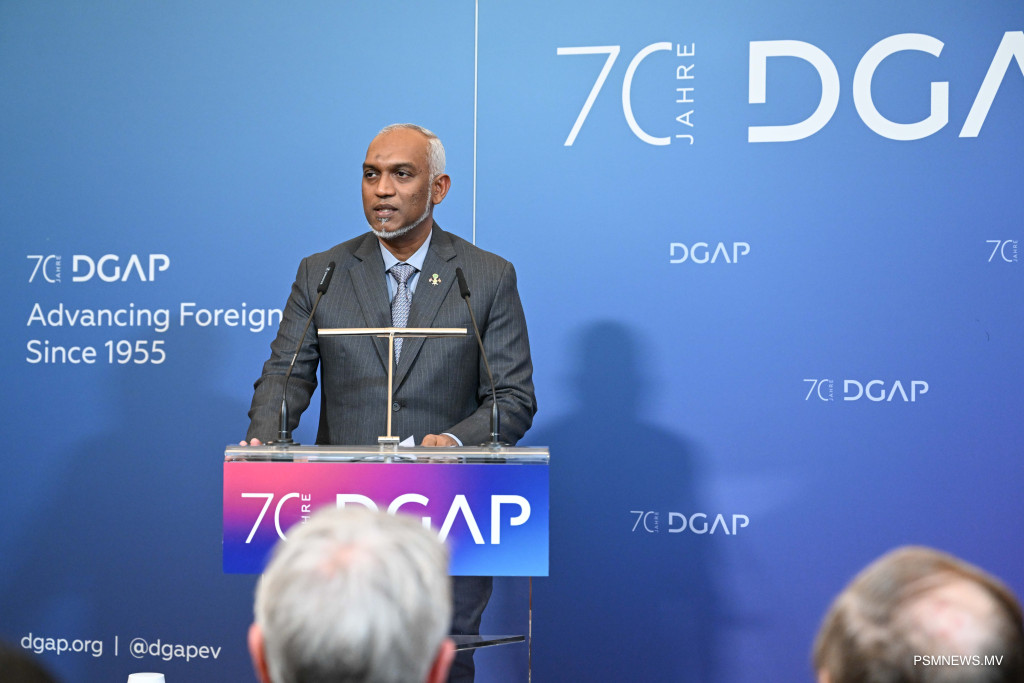
President Dr Mohamed Muizzu has declared that a foreign policy centred on the oceans is not merely a strategic preference but an existential imperative for the Maldives, underscoring the nation’s reliance on maritime governance for its survival and future.
At the German Council on Foreign Relations (DGAP), where he was received by senior leadership including Vice President Rolf Nikel, Director Thomas Kleine-Brockhoff, and Dr Kira Vinke, head of the Centre for Climate and Foreign Policy, President Muizzu outlined the Maldives’ perspective on ocean governance and the central role of the seas in foreign diplomacy.
He argued that although the ocean is indispensable to climate regulation, biodiversity, and global food security, it remains insufficiently represented in strategic and diplomatic discourse. The Maldives’ history, economy, culture, and defence, he said, are inseparably tied to the sea, and climate change threatens to disrupt both the nation’s economy and the traditional way of life of its people.
The President pointed to the Maldives’ position at the crossroads of major trade routes, noting that this geography places the country within an arena of intensifying strategic competition. He described the Indian Ocean as one of the most consequential regions of the twenty-first century and drew attention to the vulnerability of undersea digital infrastructure, which carries the vast majority of global data traffic. Safeguarding this infrastructure, he added, requires international cooperation, mutual trust, and shared regulatory norms.
President Muizzu also highlighted the growing influence of small states in shaping global norms. He said they are increasingly advocating ambitious climate action, stronger marine protection, and inclusive multilateralism. For the Maldives, he asserted, an ocean-centred foreign policy is not only existential but also indispensable for the international community. He reaffirmed his country’s readiness to work with Germany and other partners to ensure the ocean remains defined by cooperation, resilience, and shared responsibility.
In a subsequent question-and-answer session, the president elaborated on the Maldives’ approach to ocean security and resilience. He explained that the nation’s policy rests on maintaining strong relations with neighbours, respecting territorial integrity, and prioritising environmental protection. He also underscored ongoing efforts to strengthen the Maldives’ capacity to safeguard its Exclusive Economic Zone.
Closing the engagement, President Muizzu reiterated that leading global climate action remains a firm commitment for the Maldives. Reflecting on six decades of diplomatic relations with Germany, he noted significant scope for expanding cooperation, identifying shore protection initiatives as a key area for future collaboration.