

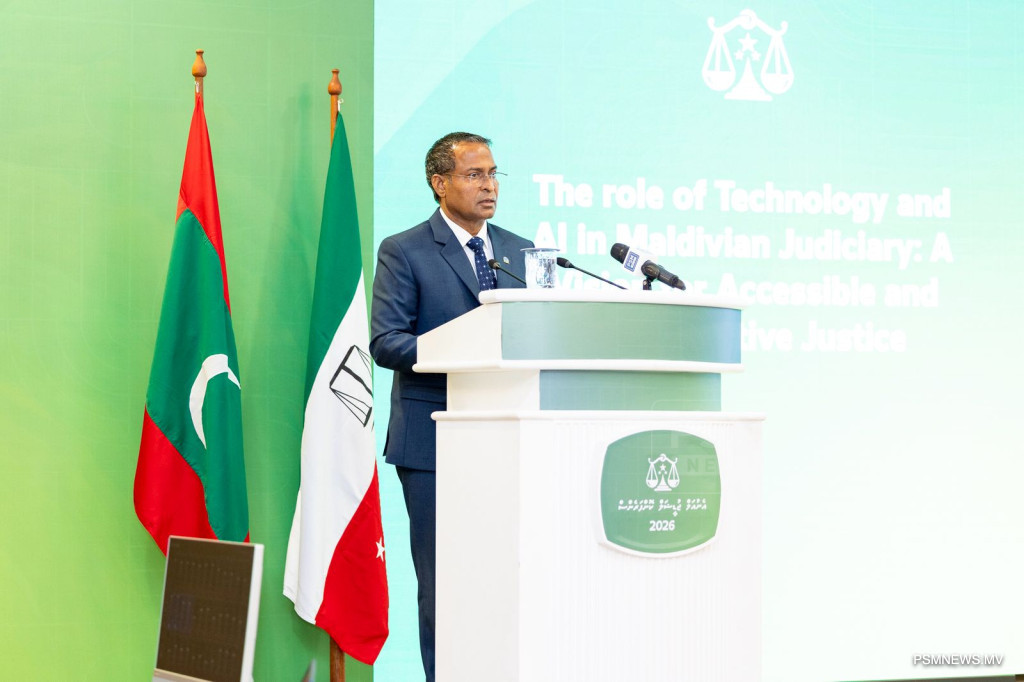
Chief Justice Abdul Ghanee Mohamed has emphasised that while technology is a powerful tool for the courts, the administration of justice must remain fundamentally guided by human thought and feeling.
The Chief Justice was speaking at the opening of the annual Judicial Conference, organised by the Judicial Academy of the Department of Judicial Administration (DJA), bringing together over 100 judicial stakeholders.
This year’s theme focuses on strengthening the judiciary through technology and artificial intelligence (AI), aiming to assess current implementations and set future goals for the sector.
While unequivocally welcoming technological progress and acknowledging that technical skills are essential in the modern age, the Chief Justice struck a note of caution. He noted that AI is already being utilised in the judicial systems of around 40 countries and can greatly ease administrative burdens. However, he warned that these tools are not a panacea and carry their own risks.
“Technological tools make things easier but do not eliminate a form of bias. Therefore, human thinking and feeling will always play an important role in establishing justice,” he said.
The Chief Justice committed to leveraging technological solutions to address persistent challenges within the judiciary, with a special focus on resolving case delays this year.
The two-day conference will feature sessions led by experts, including keynote speaker Prof Dr Hassan Ugail and facilitators from the Judicial Academy of India, exploring both the potential of AI and practical solutions for the sector’s challenges.