

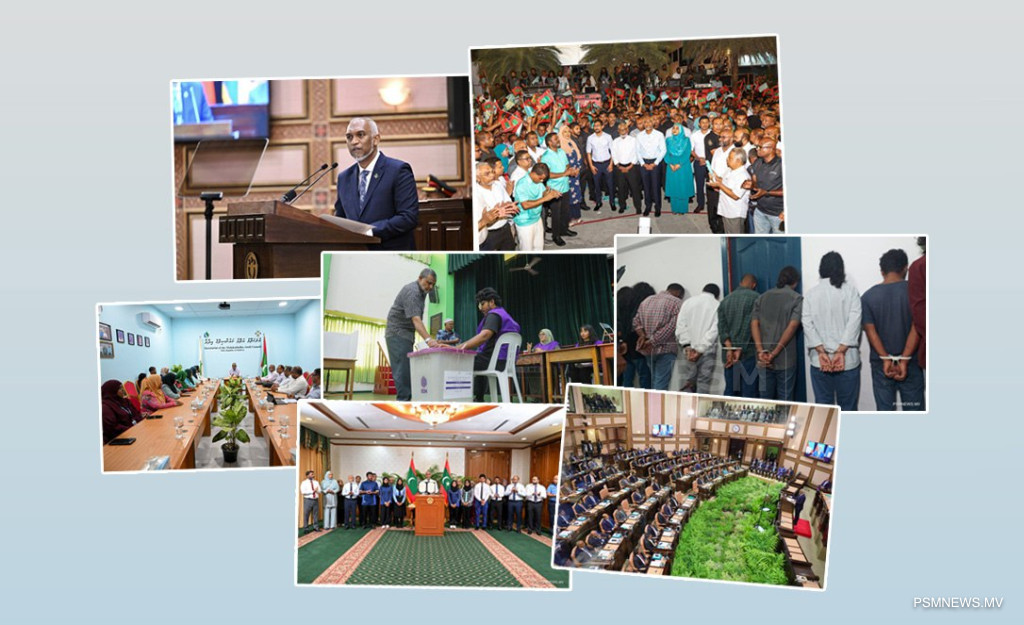
The past year marked a significant shift in the Maldives’ political landscape, with the ruling People’s National Congress (PNC) becoming the country’s largest political party, bypassing Maldivian Democratic Party (MDP) that had enjoyed the largest party status for many consecutive years. According to the Elections Commission of Maldives (ECM), PNC ended the year with 68,665 registered members, far ahead of MDP’s 43,765 registered members and other parties.
It was over the past year that the Progressive Party of Maldives (PPM) was also dissolved and consolidated under PNC, after five years of operation in coalition with PNC. Party leaders said separate political activity was unnecessary as both parties shared the same political ideology.
In 2025, internal divisions within the MDP that began ahead of the 2023 presidential election showed signs of easing when former President Mohamed Nasheed rejoined the party after leaving in 2023 to form The Democrats. However, although many that joined The Democrats have returned to MDP, factional disputes continued throughout the year, particularly on social media.
One of the most notable political incidents of 2025 was when remarks were made at MDP rallies regarding President Dr Mohamed Muizzu’s underage son, which sparked public outrage and legal action. The Human Rights Commission of the Maldives (HRCM) issued a statement, asserting that attacks on a child’s dignity were not in the spirit of free speech, and the Civil Court affirmed constitutional and international protections for children, allowing the President’s family to pursue damages.
Meanwhile, parliamentary proceedings commenced in 2025 with a failed no-confidence motion against Minister of Homeland Security and Technology, Ali Ihusan. The no-confidence motion could not be pursued due to overwhelming parliamentary support in favour of the Minister.
The year also saw a historic parliamentary moment, with the Parliament’s opening session commencing with the recitation of the Holy Quran for the first time. During the session, the President gave a detailed two-hour address outlining national projects and policies for the upcoming year.
Throughout the year, the government continued to take unprecedented action over important issues. One of the most notable actions taken by the government included amending the law to ban entry into the Maldives on Israeli passports, reaffirming its condemnation of Israeli genocide in Gaza, Palestine. The government continued to strongly condemn Israeli actions at international forums.
A landmark decision taken by the government in 2025 included a ban on the import, sale, and use of vapes and a generational smoking ban for those born after 1 January 2007. The measures aimed at creating a tobacco-free society, and the necessary legal amendments have been implemented.
One of the most important policy changes of the year was the introduction of the death penalty for drug smugglers. The President also ratified the Prevention of Gangs and Other Serious Offences Act, which granted the law enforcement agencies with strengthened powers to combat organised crime.
Under efforts to strengthen the decentralisation system, major legal amendments were brought to financially empower councils, by abolishing atoll councils and redirecting the funds allocated to atoll councils to island councils, with conditions to utilise the funds for assisting vulnerable communities. Furthermore, Women’s Development Committee (WDC) members received Ramadan allowances for the first time in 2025, and a 10 percent increase in budget. WDC Presidents were also classified as full-time members instead of part-time members.
The scope of commercial activities Local Authority companies established by local councils can partake in was also defined by law. While the rules on allocating grant aid to councils were also revised, the principles that councils must follow when making major financial decisions during the final year of their term were also determined.
Another significant political event was the holding of a referendum on the constitution of Addu City Council, facilitated through a special law. The referendum resulted in a majority vote by residents of some islands to separate from the Addu City Council and forming new administrative arrangements. The President then ratified the necessary legal amendments to give effect to the people’s decision.
Changes to the judiciary in 2025 included the honorable retirement of the Chief Justice, the first time since the new constitution came into force in 2008. Following Chief Justice Ahmed Mu’thasim Adnan’s retirement, Justice Abdul Ghanee Mohamed was appointed as his successor.
The Supreme Court bench also underwent changes, with Justices Azmiralda Zahir and Mahaz Ali Zahir dismissed by the Parliament after the Judicial Service Commission (JSC) confirmed misconduct. The JSC also started investigating the cases linked to then Supreme Court Justice Husnu-Al Suood, with which he resigned from the court. The three vacancies in the Supreme Court bench were appointed within last year, with Justice Hussain Shaheed, Justice Abdullah Hameed and Justice Mohamed Saleem.
The year ended with political parties preparing for the upcoming local council and WDC elections scheduled for April. While both PNC and MDP announced primaries to decide on candidates, PNC has already held its primary.