

Maldives marks historic year in 2025 with major advances in diplomacy, infrastructure, and social reform
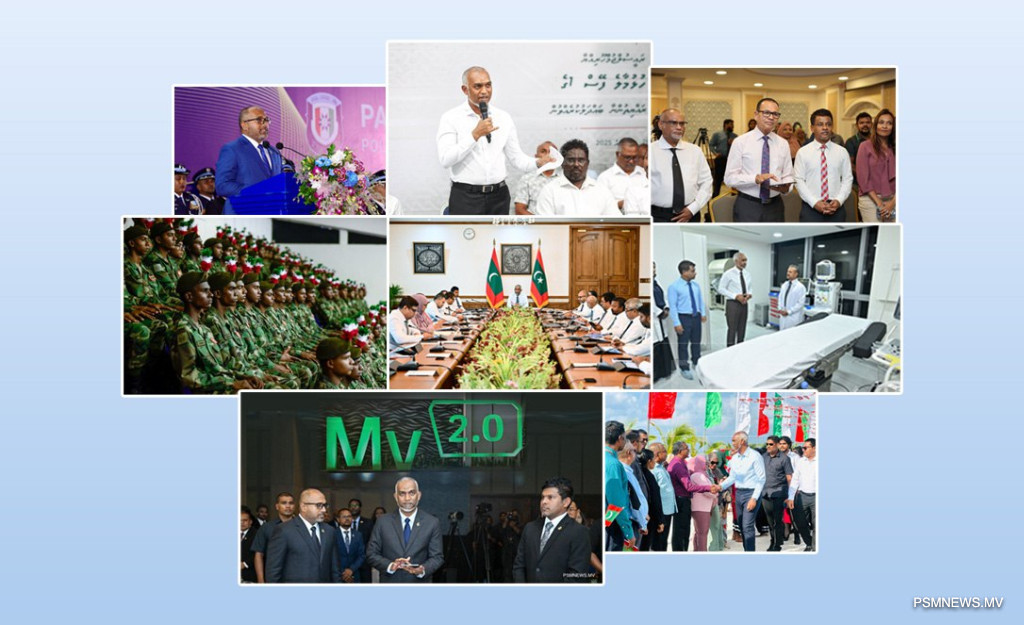
For Maldives, 2025 has been a landmark, marked by transformative developments across governance, economy, health, tourism, and international relations.
The year began with the full implementation of the Maldives-China Free Trade Agreement, the nation’s first, boosting bilateral trade with duty-free access to key markets.
President Dr Mohamed Muizzu launched an unprecedented series of nationwide island visits, engaging local councils, launching development projects, and inaugurating the Bank of Maldives (BML) ATM Project to ensure banking access in all islands.
In a significant move toward financial inclusivity, the government raised the travel debit card limit for Umrah pilgrims to USD 1,750. The national carrier, Maldivian, welcomed its first wide-body A330 aircraft, enhancing air connectivity. A major police infrastructure expansion was initiated, with new stations set for 75 islands, while a historic generational tobacco ban was announced, prohibiting tobacco sales to anyone born after 2007
The Maldives established its first-ever embassy in Turkiye, signaling growing diplomatic outreach. On 9 May, the government launched ‘Maldives 2.0,’ an ambitious digital transformation initiative aimed at modernising public services and curbing corruption. Key infrastructure milestones included the opening of the new international terminal at Velana International Airport (VIA)—capable of handling seven million tourists annually—and the redeveloped Hanimaadhoo International Airport, set to boost northern tourism.
The year also saw the launch of the Mecca Route Initiative, streamlining Hajj and Umrah travel, and the introduction of the "Hiyaavahi Finance for Housing" scheme offering 25-year, 5 percent Islamic Shariah compliant loans. President Muizzu inaugurated the first airport in Meemu Atoll and a new patriotic youth service, while historic diplomatic visits from Indian Prime Minister Narendra Modi and Sri Lankan President Anura Kumara Dissanayake strengthened regional ties.
In social welfare, the Hafiz allowance was increased to USD 259.40 and the basic food import list was expanded to include fresh produce. Addu City saw administrative changes after a referendum led to the separation of Hulhudhoo and Meedhoo islands from the city council.
The year also saw segment one of the Bodu Thakurufaanu magu expansion inauguration, marking progress in the infrastructure project awarded to the Maldives Transport and Contracting Company (MTCC). The newly widened 130-metre stretch near the Shaheed Hussain Adam Building features modern drainage systems and improved road canals.
National ID card printing services was launched for Maldivians living in Sri Lanka 16, enabling citizens to obtain identification cards through the Maldives High Commission. Following Sri Lanka Malaysia, the service is set to expand to the UK, streamlining documentation for the Maldivian diaspora.
The year concluded on a humanitarian note, with PSM’s “Maldivians with Ceylon” telethon raising over USD 800,000 for flood-stricken Sri Lanka.
Maldives, was named “World’s Most Popular Destination”—2025 remains a defining year of progress, innovation, and national renewal for the Maldives.