

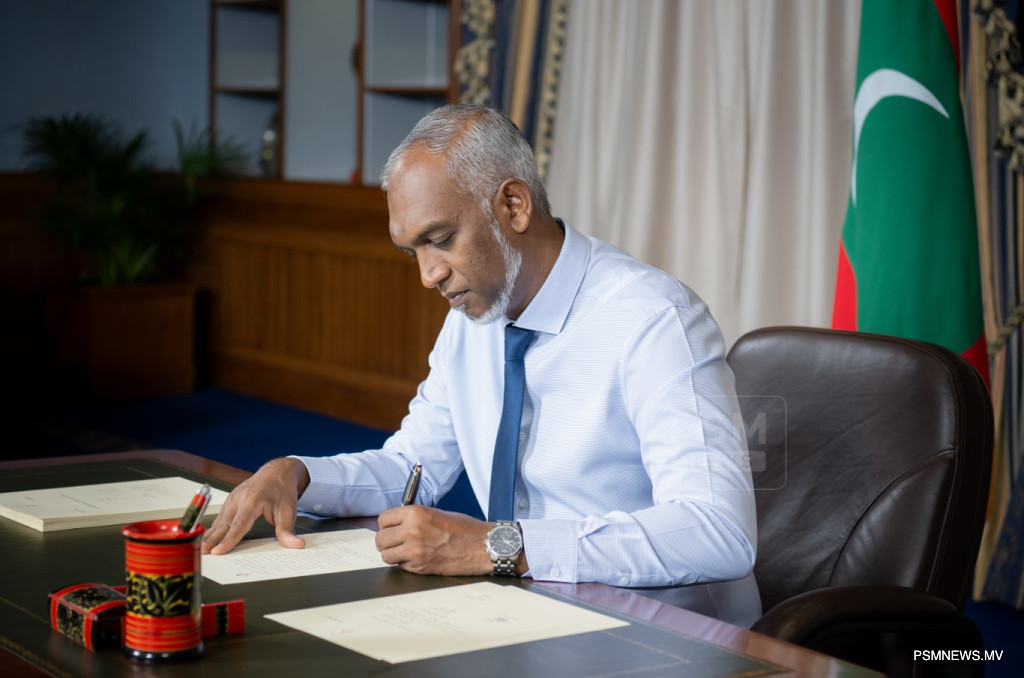
President Dr Mohamed Muizzu on Sunday ratified three critical bills, including a constitutional amendment, officially paving the way for the abolition of Atoll Councils and introducing a comprehensive restructuring of the nation’s local governance system.
The move, characterized by the administration as an effort to strengthen grassroots democracy, shifts administrative authority primarily to Local Island Councils and introduces significant reforms regarding council composition and political accountability.
The core change is initiated by the Constitutional Amendment, passed by Parliament on 25 November, which removes the requirement to establish Atoll Councils as part of the decentralisation framework. This abolition will take effect following the next scheduled local council elections. The existing Atoll Councils will continue their mandate until the newly elected councils assume office.
The subsequent amendment to the Decentralisation of Administrative Areas Act, ratified after passing the Parliament on 27 November, confirms that the 21 administrative divisions will henceforth be governed solely by Island Councils. This amendment formalises the new administrative structure and mandates increased female representation. Island Councils on islands with populations exceeding 2,000 are now required to elect five members, with two positions strictly reserved for women. Smaller islands will elect three councilors.
Further changes address the structure of urban governance and accountability. City Councils have been restructured, with membership determined either by the number of parliamentary seats allocated to the city or by electing one member from each island within the city’s jurisdiction.
Crucially, the reforms empower the Women's Development Committee (WDC). The WDC Chairperson will now be directly elected by the public and serve in a full-time capacity. Additionally, the new law secures a seat on the Local Government Authority (LGA) Board for a representative elected from among the WDC chairpersons, ensuring their voices are integrated into top-tier local governance decision-making.
Additionally, the newly approved legislation tightens political accountability measures for elected officials. Councilors elected on a party ticket will now face mandatory resignation—thereby vacating their seat—if they formally register with the Election Commission of Maldives (ECM) as a member of a different political party while serving their term.
Finally, the amendment to the Local Councils Election Act mandates that by-elections to fill vacant local council seats must now be conducted twice a year, ensuring greater continuity in local administration. All three approved bills have been gazetted and are now in effect.